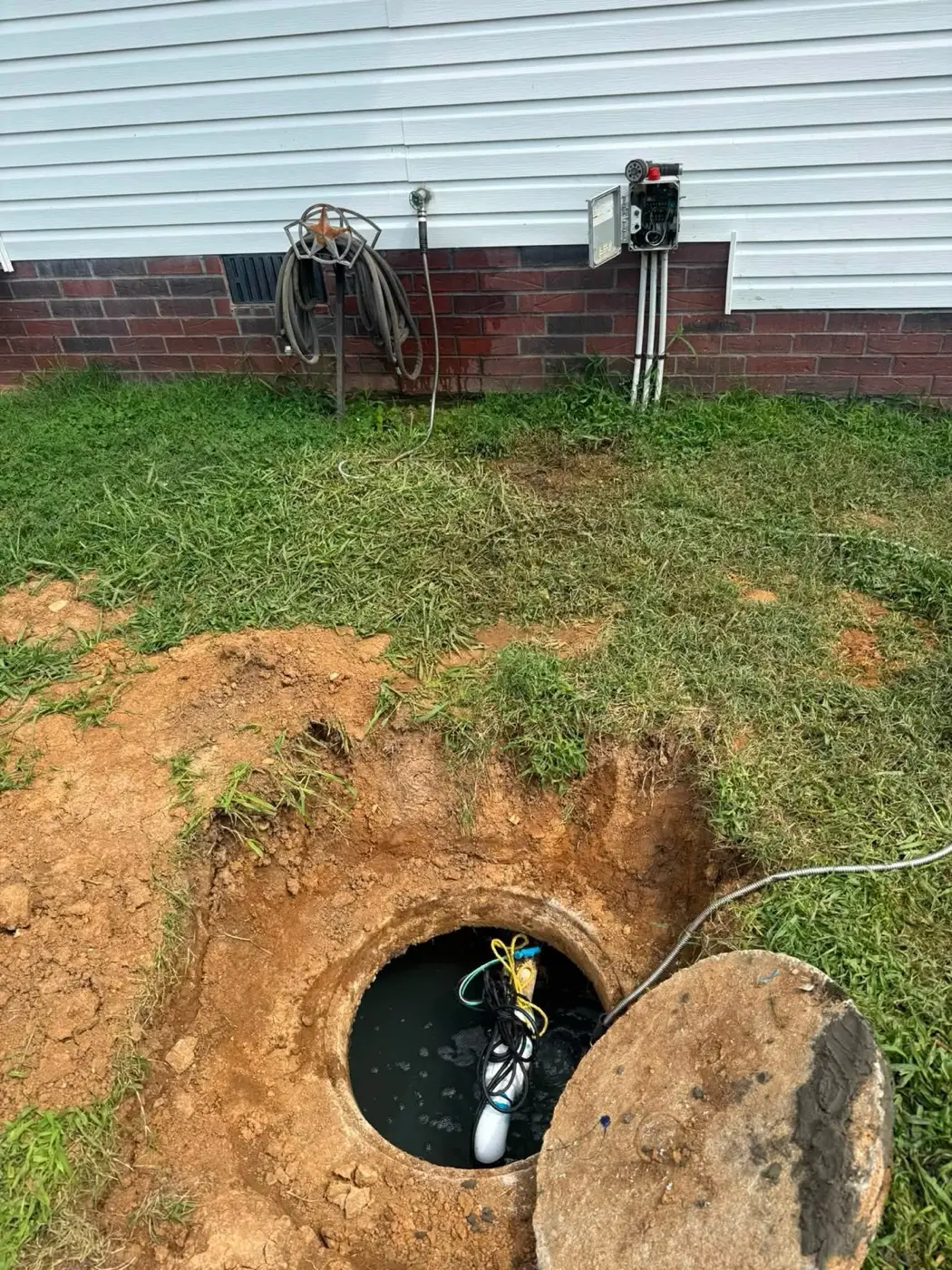
Septic tank repair vs replacement: how to tell which one you need
If the tank shell is sound and the drain field still absorbs water, you are probably looking at a repair. Baffles, lids, risers, filters, pumps, distribution boxes, and broken lines are all replaceable parts. Replacement is the call when the tank has structurally failed, the drain field has sealed over, or the system is undersized for the house it serves.
That is the whole decision in four sentences. The rest of this guide puts numbers and failure signs behind it, so you can tell which conversation you are about to have.
What can be repaired, and what does it cost?
Most septic problems live in the parts around the tank, not the tank itself. Those parts fail one at a time and get fixed one at a time.
| Repair | Typical cost (national) |
|---|---|
| Effluent filter | $200 to $300 |
| Tank lid | $150 to $500 |
| Riser installation | $200 to $400 |
| Inlet or outlet baffle | $250 to $900 |
| Pump repair | $250 to $400 |
| Pump replacement | $500 to $1,300 |
| Distribution box | $500 to $1,500 |
| Broken line repair | $1,000 to $4,200 |
| Crack patch in a concrete tank | $500 to $850 |
| Root removal | $600 to $1,600 |
Sources: HomeGuide and Angi 2026 cost data. Across all repair types, the typical job lands between about $600 and $3,000, with a national average near $1,900. These are market figures, not our prices; every real number comes from opening the system and looking. That first look is exactly what our septic tank repair service does.
What failures mean replacement?
Three failure modes do not repair their way out:
- A sealed drain field. The EPA describes how the biomat layer in the trenches thickens as a field passes 25 to 30 years, until water ponds on the surface or backs up into the house. New pipe in sealed trenches clogs again; the field has to move to fresh soil.
- A structurally failed tank. Large cracks, rust-through on steel, or a collapsing shell. A patch holds on a small crack in sound concrete. A tank that is crumbling, or a crack that keeps reopening, means the tank is done.
- An undersized system. Not damage, just arithmetic. Systems are sized by bedroom count, and a house that grew past its permit overloads a healthy field.
Replacement numbers, for scale: a new tank alone runs about $3,000 to $8,500 installed. A replacement drain field runs $3,000 to $15,000. The EPA puts a malfunctioning system’s repair-or-replace bill at $5,000 to $15,000. A full new system is the subject of our guide to what a septic system costs in Tennessee, and the work itself is a full septic system replacement.
How do age and repeat failures shift the math?
The trade rule of thumb says that when a repair costs more than half of replacement value, replace. Treat that as an industry heuristic, not a regulation, but the logic underneath it is sound.
Lifespans anchor the math. A concrete tank commonly lasts 40 years or more. Steel runs about 20 to 25. Drain fields last 15 to 30 years with care. So a $900 baffle on a 12 year old concrete tank is money well spent. The same $900 on a 35 year old tank sitting over a ponding field is a deposit on a replacement you are going to buy anyway.
Repeat failures tell the same story. When the pumping truck comes more often, the repairs stack up, and the field stays wet between visits, the system is telling you where it is headed. Budget for the replacement on your schedule instead of an emergency’s.
Does Tennessee require a permit for septic repairs?
Yes. TDEC requires a construction permit for repairing a faulty system, though the state charges no fee for the repair permit itself, just a $100 inspection. Williamson County, which runs its own septic program, writes it even more plainly: it is unlawful to construct, alter, extend, or repair a system without a county permit, and the installer doing it for hire has to be county licensed.
The county’s rules even contain their own repair-or-replace test. An existing documented system may continue in use unless the system fails and cannot reasonably be repaired in its current location. When the county reaches that finding, the decision has been made for you.
Frequently asked questions
Can a septic tank be repaired instead of replaced?
Often, yes. Baffles, lids, risers, effluent filters, pumps, distribution boxes, and broken lines are all replaceable parts. Small cracks in a concrete tank can be sealed. Replacement enters the picture when the tank shell is failing, the drain field is sealed with biomat, or the system is undersized for the house.
How much does septic tank repair cost?
National data puts typical septic repairs between about $600 and $3,000, with the average around $1,900. Small items sit lower: an effluent filter around $200 to $300, a lid $150 to $500, a baffle $250 to $900. A line repair runs roughly $1,000 to $4,200 depending on length.
How much does septic replacement cost?
A new tank alone runs about $3,000 to $8,500 installed. A replacement drain field runs $3,000 to $15,000. The EPA puts repairing or replacing a malfunctioning full system at $5,000 to $15,000, and complex engineered replacements can go higher.
How long do septic tanks and drain fields last?
A concrete tank commonly lasts 40 years or more, steel around 20 to 25, and plastic or fiberglass 30 to 40. Drain fields run 15 to 30 years with care. The EPA notes that past 25 to 30 years, the biomat layer in the trenches thickens and the field’s ability to drain falls off.
Do septic repairs need a permit in Tennessee?
Yes. TDEC requires a construction permit to repair a faulty system, though the repair permit itself carries no state fee. In Williamson County, the county’s own regulations make it unlawful to repair a system without a county permit, and your installer has to be licensed with the county.
Not sure which side of the line your system is on? That is the first thing we figure out, and the look costs nothing. Call Septic Superior at (615) 957-9682. If the field is the problem rather than the tank, our guide to pumping frequency shows how to protect the one you have left.